Sub Menu Here
Hydrogen peroxide (H2O2) is an oxidising agent with industrial applications across water treatment, paper manufacture and many more sectors. In this article, our product experts are exploring this versatile, environmentally-friendly chemical compound in a little more detail.
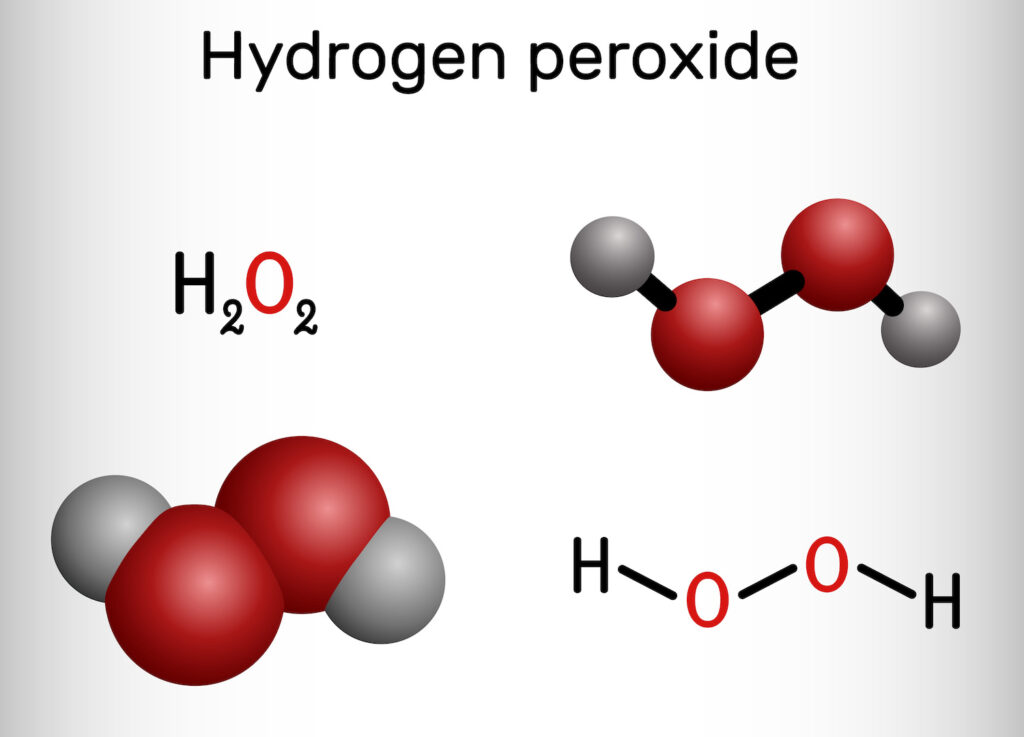
Hydrogen peroxide has the chemical formula H2O2 — it is essentially water (H2O) with one extra oxygen atom. It is a colourless liquid that is slightly thicker than water.
H2O2’s structure makes it a very effective and powerful oxidising agent. When added to a substance, it can produce highly-reactive free radicals. These can oxidise a wide range of organic and inorganic compounds, even those considered harder to oxidise (like solvents, gasoline and pesticides).
When something is oxidised, it loses electrons — this weakens chemical bonds. H2O2’s oxidising capability is central to its suitability for a range of important industrial applications.
In the example of water treatment and purification, when a microbial cell membrane is oxidised, its structure is damaged and the cell is killed. After decomposing, the end products are simply water and oxygen with release of heat — there are no harmful, environmentally-damaging residues.
Effective against viruses, bacteria, yeasts, and bacterial spores, H2O2’s oxidising properties make it useful for sterilising surfaces, such as surgical tools. As a vapour, it can be used for room sterilisation.
In textiles, this oxidising action can bleach colours from substances. In fertilisers, it can oxygenate and disinfect soils. With certain other compounds, it can react to form hydroperoxides or other peroxides.
Hydrogen peroxide’s potent oxidising capabilities are at the heart of its role in many industrial processes and products. Because its concentration and dosage can be easily adjusted, it is highly versatile.
The chemical also has uses in agricultural fertilisers, veterinary practice (for disinfecting wounds), oil and gas exploration, metal processing and even as a component in rocket fuels.
Whilst a mainstay of industry, in lower concentrations, hydrogen peroxide is a common ‘green’ alternative to chlorine in a number of household products. H2O2 can be found in cleaning solutions, laundry detergents, stain removers, mould killers, plant care products, ear wax drops, toothpastes, mouthwashes and tooth whitening products. 3–5% solutions can also be used as an alternative to bleach for cleaning purposes.
Compared to traditional oxidants like chlorine, hydrogen peroxide produces no harmful residues or gas release. The only by-product of hydrogen peroxide’s oxidation is water.
In 1818, French chemist Louis Jacques Thénard stumbled upon eau d’oxygénée — or oxygenated water — now known as hydrogen peroxide. It was originally noted for its bleaching effect.
Early production methods were inefficient, only yielding low volumes and concentrations. However, in the 1930s, the anthraquinone process was developed, marking a significant advancement. It involves a cyclic reaction where anthraquinone is hydrogenated and then oxidised. H2O2 is extracted from the reaction mixture and purified — an hugely efficient process that yields high concentrations.
By the end of the century, 2.7 million tonnes of H2O2 were being produced — up from only 35,000 tonnes in 1950. The anthraquinone process is still the main production method today, accounting for 95% of all H2O2 produced.
In lower concentrations, such as 3–5%, hydrogen peroxide is widely available to buy. It is illegal to sell concentrations of hydrogen peroxide greater than 12% to the public in the UK; these are only available with a safety data sheet (SDS); two of the most popular dilutions we supply for industrial purposes are 35% and 50%.
At these higher concentrations, hydrogen peroxide is corrosive and can cause burns to skin and eyes. Even domestic strength concentrations can be dangerous, particularly if they come in contact with eyes. Gloves and eye protection should be worn when handling this chemical.
H2O2 can cause spontaneous combustion when it comes in contact with certain organic materials — it should be stored safely away from any organic or combustible materials in a cool, dry, ventilated space. The container should be non-reactive, opaque and away from sunlight; H2O2 breaks down when exposed to light. Many formulations come in a brown bottle to block out light.
Driven by its wide-ranging applications and status as an environmentally-friendly oxidant, demand for hydrogen peroxide is anticipated to continue growing through late 2020s and early 2030s.
The global market size for hydrogen peroxide is forecast to see a compound annual growth rate (CAGR) of 5.6%, reaching a value of £8.1 billion (€9.46 billion) by 2032 — up from £5 billion (€5.85 billion) in 2023.
If you’re looking for a hydrogen peroxide supplier and distributor, we would be delighted to hear from you. At Airedale Group, we have been trading in this particular commodity chemical since 1997. We offer a range of strengths and pack sizes to meet your requirements with fast, secure delivery across the UK and Europe.